
Lowest Spread Forex Brokers in 2026: 19 Standard Accounts Tested
In our 2026 comparison of the lowest spread Forex brokers, IC Markets ranked first with an average spread of 0.97 pips across 7 major currency pairs. The ranking is based on 67,659 synchronized one-minute observations from 19 Standard and standard-equivalent accounts. Exness recorded the study’s lowest average EUR/USD spread at 0.80 pips.
Tested Research by  Sakkarin Grinara Updated
Lowest Spread Forex Brokers: Full 2026 Ranking
Scope: Standard/Standard-equivalent accounts · spreads only · not total trading cost.
Swipe to see all columns.
| Rank | Broker | ||||||||
|---|---|---|---|---|---|---|---|---|---|
| #1 |  IC Markets Open Account IC Markets Open Account | 0.97 | 0.86 pips, relative band 1 of 5 | 0.91 pips, relative band 1 of 5 | 0.99 pips, relative band 1 of 5 | 0.88 pips, relative band 1 of 5 | 0.98 pips, relative band 1 of 5 | 1.00 pips, relative band 1 of 5 | 1.18 pips, relative band 1 of 5 |
| #2 |  FBS Open Account FBS Open Account | 1.05 | 0.94 pips, relative band 1 of 5 | 0.96 pips, relative band 1 of 5 | 1.08 pips, relative band 1 of 5 | 1.10 pips, relative band 1 of 5 | 1.12 pips, relative band 1 of 5 | 0.95 pips, relative band 1 of 5 | 1.20 pips, relative band 1 of 5 |
| #3 |  Pepperstone Open Account Pepperstone Open Account | 1.11 | 1.01 pips, relative band 1 of 5 | 1.09 pips, relative band 1 of 5 | 1.10 pips, relative band 1 of 5 | 1.07 pips, relative band 1 of 5 | 1.21 pips, relative band 1 of 5 | 1.09 pips, relative band 1 of 5 | 1.21 pips, relative band 1 of 5 |
| #4 |  Exness Open Account Exness Open Account | 1.12 | 0.80 pips, relative band 1 of 5 | 1.00 pips, relative band 1 of 5 | 1.00 pips, relative band 1 of 5 | 0.90 pips, relative band 1 of 5 | 1.46 pips, relative band 2 of 5 | 1.30 pips, relative band 2 of 5 | 1.40 pips, relative band 1 of 5 |
| #5 |  Eightcap Open Account Eightcap Open Account | 1.24 Footnote 1: three-decimal rounding note. | 1.05 pips, relative band 2 of 5 | 1.18 pips, relative band 1 of 5 | 1.19 pips, relative band 1 of 5 | 1.27 pips, relative band 2 of 5 | 1.29 pips, relative band 1 of 5 | 1.39 pips, relative band 2 of 5 | 1.30 pips, relative band 1 of 5 |
| #6 |  OANDA Open Account OANDA Open Account | 1.24 Footnote 1: three-decimal rounding note. | 0.86 pips, relative band 1 of 5 | 1.13 pips, relative band 1 of 5 | 1.24 pips, relative band 2 of 5 | 1.00 pips, relative band 1 of 5 | 1.54 pips, relative band 2 of 5 | 1.38 pips, relative band 2 of 5 | 1.55 pips, relative band 1 of 5 |
| #7 |  JustMarkets Open Account JustMarkets Open Account | 1.26 | 0.90 pips, relative band 1 of 5 | 1.30 pips, relative band 2 of 5 | 1.04 pips, relative band 1 of 5 | 1.04 pips, relative band 1 of 5 | 1.52 pips, relative band 2 of 5 | 1.23 pips, relative band 1 of 5 | 1.83 pips, relative band 2 of 5 |
| #8 |  FP Markets Open Account FP Markets Open Account | 1.37 | 1.13 pips, relative band 2 of 5 | 1.31 pips, relative band 2 of 5 | 1.21 pips, relative band 1 of 5 | 1.38 pips, relative band 2 of 5 | 1.50 pips, relative band 2 of 5 | 1.46 pips, relative band 2 of 5 | 1.57 pips, relative band 1 of 5 |
| #9 |  VT Markets Open Account VT Markets Open Account | 1.44 | 1.36 pips, relative band 3 of 5 | 1.86 pips, relative band 4 of 5 | 1.56 pips, relative band 3 of 5 | 1.36 pips, relative band 2 of 5 | 1.15 pips, relative band 1 of 5 | 1.25 pips, relative band 1 of 5 | 1.55 pips, relative band 1 of 5 |
| #10 |  Vantage Open Account Vantage Open Account | 1.46 | 1.36 pips, relative band 3 of 5 | 1.86 pips, relative band 4 of 5 | 1.56 pips, relative band 3 of 5 | 1.46 pips, relative band 2 of 5 | 1.15 pips, relative band 1 of 5 | 1.35 pips, relative band 2 of 5 | 1.45 pips, relative band 1 of 5 |
| #11 |  RoboForex Open Account RoboForex Open Account | 1.48 | 1.33 pips, relative band 3 of 5 | 1.96 pips, relative band 4 of 5 | 1.30 pips, relative band 2 of 5 | 1.64 pips, relative band 3 of 5 | 1.62 pips, relative band 2 of 5 | 1.20 pips, relative band 1 of 5 | 1.28 pips, relative band 1 of 5 |
| #12 |  Tickmill Open Account Tickmill Open Account | 1.63 Footnote 1: three-decimal rounding note. | 1.60 pips, relative band 4 of 5 | 1.65 pips, relative band 3 of 5 | 1.67 pips, relative band 3 of 5 | 1.60 pips, relative band 3 of 5 | 1.62 pips, relative band 2 of 5 | 1.63 pips, relative band 3 of 5 | 1.62 pips, relative band 1 of 5 |
| #13 |  LiteFinance Open Account LiteFinance Open Account | 1.63 Footnote 1: three-decimal rounding note. | 1.50 pips, relative band 4 of 5 | 1.90 pips, relative band 4 of 5 | 1.60 pips, relative band 3 of 5 | 1.60 pips, relative band 3 of 5 | 1.60 pips, relative band 2 of 5 | 1.60 pips, relative band 3 of 5 | 1.60 pips, relative band 1 of 5 |
| #14 |  FxPro Open Account FxPro Open Account | 1.81 | 1.40 pips, relative band 3 of 5 | 1.50 pips, relative band 2 of 5 | 1.60 pips, relative band 3 of 5 | 1.90 pips, relative band 4 of 5 | 1.70 pips, relative band 2 of 5 | 1.90 pips, relative band 4 of 5 | 2.70 pips, relative band 4 of 5 |
| #15 |  XTB Open Account XTB Open Account | 1.86 | 1.65 pips, relative band 4 of 5 | 1.90 pips, relative band 4 of 5 | 1.63 pips, relative band 3 of 5 | 1.71 pips, relative band 3 of 5 | 2.12 pips, relative band 3 of 5 | 1.92 pips, relative band 4 of 5 | 2.06 pips, relative band 2 of 5 |
| #16 |  OctaFX Open Account OctaFX Open Account | 1.96 | 1.39 pips, relative band 3 of 5 | 2.38 pips, relative band 5 of 5 | 1.99 pips, relative band 5 of 5 | 1.99 pips, relative band 4 of 5 | 2.29 pips, relative band 4 of 5 | 1.69 pips, relative band 3 of 5 | 1.99 pips, relative band 2 of 5 |
| #17 |  HFM Open Account HFM Open Account | 2.08 | 1.73 pips, relative band 5 of 5 | 2.36 pips, relative band 5 of 5 | 2.18 pips, relative band 5 of 5 | 1.78 pips, relative band 4 of 5 | 2.22 pips, relative band 4 of 5 | 2.04 pips, relative band 4 of 5 | 2.26 pips, relative band 3 of 5 |
| #18 |  AvaTrade Open Account AvaTrade Open Account | 2.09 | 1.30 pips, relative band 3 of 5 | 1.50 pips, relative band 2 of 5 | 2.00 pips, relative band 5 of 5 | 1.80 pips, relative band 4 of 5 | 2.50 pips, relative band 4 of 5 | 2.00 pips, relative band 4 of 5 | 3.50 pips, relative band 5 of 5 |
| #19 |  XM Open Account XM Open Account | 2.45 | 1.93 pips, relative band 5 of 5 | 2.41 pips, relative band 5 of 5 | 2.22 pips, relative band 5 of 5 | 2.38 pips, relative band 5 of 5 | 2.90 pips, relative band 5 of 5 | 2.46 pips, relative band 5 of 5 | 2.81 pips, relative band 4 of 5 |
Pair leaders in the 19-account publication set: IC Markets led 5 of seven pair tables ; Exness on EUR/USD and FBS on USD/CHF led the remaining pairs.
Footnote 1 Rounding note: Editorial spread values in this article are displayed to two decimal places. Brokers are ordered by the underlying averages, and three-decimal values are shown here only where two displayed 7-pair averages look equal but retain different ranks.
- Both display as 1.24 pips: Eightcap (#5) is 1.238 pips; OANDA (#6) is 1.243 pips.
- Both display as 1.63 pips: Tickmill (#12) is 1.628 pips; LiteFinance (#13) is 1.629 pips.
Heat colors compare brokers within each pair. Select a column header to sort the table.
Spread Statistics for All 19 Forex Brokers
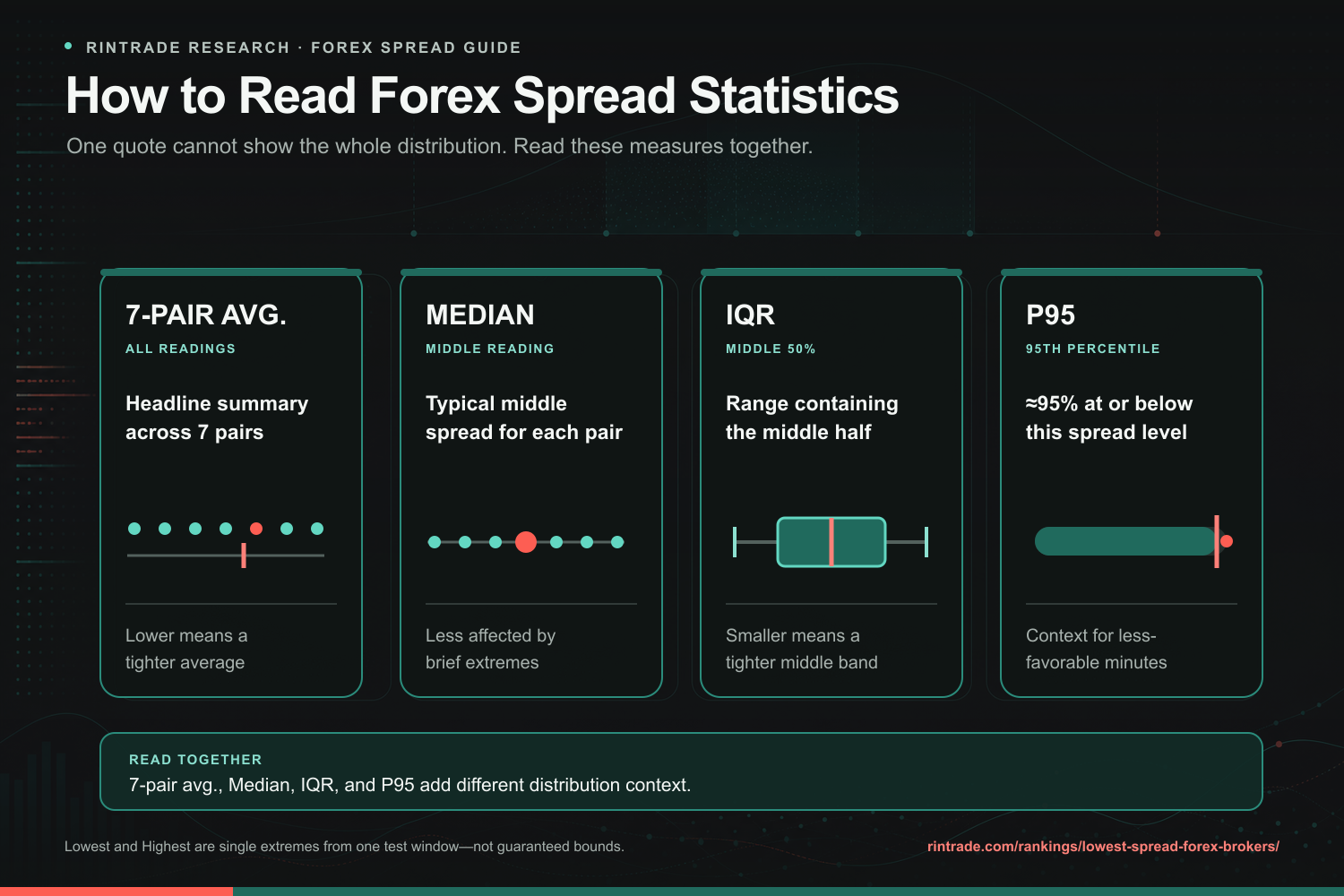
This table compares the distribution statistics for the seven primary currency pairs in one place. The 7-pair avg. is the only ranking metric. Median, IQR, P95, Lowest, and Highest add context. Select a statistic heading to sort it.
Swipe to see all columns.
| Rank | Broker | ||||||
|---|---|---|---|---|---|---|---|
| #1 | IC Markets Open Account | 0.97 , heat band 1 of 5 | 0.97 , heat band 1 of 5 | 0.11 , heat band 3 of 5 | 1.10 , heat band 1 of 5 | 0.80 , heat band 1 of 5 | 1.60 , heat band 1 of 5 |
| #2 | FBS Open Account | 1.05 , heat band 1 of 5 | 1.03 , heat band 1 of 5 | 0.06 , heat band 2 of 5 | 1.14 , heat band 1 of 5 | 0.80 , heat band 1 of 5 | 1.40 , heat band 1 of 5 |
| #3 | Pepperstone Open Account | 1.11 , heat band 1 of 5 | 1.11 , heat band 1 of 5 | 0.04 , heat band 2 of 5 | 1.21 , heat band 1 of 5 | 1.00 , heat band 2 of 5 | 1.70 , heat band 1 of 5 |
| #4 | Exness Open Account | 1.12 , heat band 1 of 5 | 1.11 , heat band 1 of 5 | 0.03 , heat band 1 of 5 | 1.14 , heat band 1 of 5 | 0.80 , heat band 1 of 5 | 1.60 , heat band 1 of 5 |
| #5 | Eightcap Open Account | 1.24 Footnote 1: three-decimal rounding note. , heat band 1 of 5 | 1.24 , heat band 1 of 5 | 0.11 , heat band 3 of 5 | 1.37 , heat band 1 of 5 | 1.00 , heat band 2 of 5 | 1.70 , heat band 1 of 5 |
| #6 | OANDA Open Account | 1.24 Footnote 1: three-decimal rounding note. , heat band 1 of 5 | 1.24 , heat band 1 of 5 | 0.11 , heat band 3 of 5 | 1.39 , heat band 1 of 5 | 0.60 , heat band 1 of 5 | 1.80 , heat band 1 of 5 |
| #7 | JustMarkets Open Account | 1.26 , heat band 1 of 5 | 1.26 , heat band 1 of 5 | 0.06 , heat band 2 of 5 | 1.33 , heat band 1 of 5 | 0.90 , heat band 2 of 5 | 2.10 , heat band 2 of 5 |
| #8 | FP Markets Open Account | 1.37 , heat band 2 of 5 | 1.37 , heat band 2 of 5 | 0.13 , heat band 4 of 5 | 1.51 , heat band 2 of 5 | 1.10 , heat band 2 of 5 | 1.80 , heat band 1 of 5 |
| #9 | VT Markets Open Account | 1.44 , heat band 2 of 5 | 1.44 , heat band 2 of 5 | 0.10 , heat band 3 of 5 | 1.50 , heat band 2 of 5 | 1.10 , heat band 2 of 5 | 2.80 , heat band 4 of 5 |
| #10 | Vantage Open Account | 1.46 , heat band 2 of 5 | 1.46 , heat band 2 of 5 | 0.10 , heat band 3 of 5 | 1.53 , heat band 2 of 5 | 1.10 , heat band 2 of 5 | 2.80 , heat band 4 of 5 |
| #11 | RoboForex Open Account | 1.48 , heat band 2 of 5 | 1.47 , heat band 2 of 5 | 0.07 , heat band 2 of 5 | 1.53 , heat band 2 of 5 | 1.20 , heat band 3 of 5 | 3.00 , heat band 4 of 5 |
| #12 | Tickmill Open Account | 1.63 Footnote 1: three-decimal rounding note. , heat band 3 of 5 | 1.60 , heat band 3 of 5 | 0.04 , heat band 2 of 5 | 1.70 , heat band 3 of 5 | 1.60 , heat band 4 of 5 | 1.90 , heat band 2 of 5 |
| #13 | LiteFinance Open Account | 1.63 Footnote 1: three-decimal rounding note. , heat band 3 of 5 | 1.63 , heat band 3 of 5 | 0.00 , heat band 1 of 5 | 1.63 , heat band 2 of 5 | 1.50 , heat band 4 of 5 | 1.90 , heat band 2 of 5 |
| #14 | FxPro Open Account | 1.81 , heat band 3 of 5 | 1.81 , heat band 3 of 5 | 0.00 , heat band 1 of 5 | 1.84 , heat band 3 of 5 | 1.20 , heat band 3 of 5 | 2.70 , heat band 4 of 5 |
| #15 | XTB Open Account | 1.86 , heat band 4 of 5 | 1.87 , heat band 4 of 5 | 0.07 , heat band 2 of 5 | 1.94 , heat band 3 of 5 | 1.30 , heat band 3 of 5 | 2.80 , heat band 4 of 5 |
| #16 | OctaFX Open Account | 1.96 , heat band 4 of 5 | 1.97 , heat band 4 of 5 | 0.00 , heat band 1 of 5 | 1.97 , heat band 3 of 5 | 1.30 , heat band 3 of 5 | 2.40 , heat band 3 of 5 |
| #17 | HFM Open Account | 2.08 , heat band 4 of 5 | 2.06 , heat band 4 of 5 | 0.20 , heat band 5 of 5 | 2.31 , heat band 5 of 5 | 1.60 , heat band 4 of 5 | 3.10 , heat band 5 of 5 |
| #18 | AvaTrade Open Account | 2.09 , heat band 4 of 5 | 2.09 , heat band 4 of 5 | 0.00 , heat band 1 of 5 | 2.09 , heat band 4 of 5 | 1.30 , heat band 3 of 5 | 3.50 , heat band 5 of 5 |
| #19 | XM Open Account | 2.45 , heat band 5 of 5 | 2.44 , heat band 5 of 5 | 0.11 , heat band 3 of 5 | 2.59 , heat band 5 of 5 | 1.90 , heat band 5 of 5 | 3.30 , heat band 5 of 5 |
What These Spread Statistics Tell a Forex Trader
Forex spreads change throughout the trading day. Use these figures together to see each broker's typical spread, how stable it was, and how wide it became during this test.
- 7-pair avg.
- The ranking metric. We calculated the average spread for each of the seven major pairs, then gave each pair equal weight. Lower means tighter quoted spreads during this test.
- Median
- We found the median, or typical spread, for each pair, then averaged the seven results equally. It is less affected by brief spread spikes than the 7-pair avg.
- IQR
- Shows how tightly the middle spread readings were grouped. We calculated the IQR for each pair, then averaged the seven results equally. Lower means the middle 50% stayed within a narrower range. A displayed IQR of 0.00 means the average rounds to 0.00 pip; it does not mean the spread itself was zero.
- P95
- Shows the wider-spread end of the test. We calculated P95 for each pair, then averaged the seven results equally. For each pair, about 95% of readings were at or below its P95. Lower means tighter spreads near the wide end of the test.
- Lowest and Highest
- The lowest and highest individual spread readings across the seven major pairs during this test. They are the test's extremes, not spreads the broker will always quote.
How to Choose a Low-Spread Forex Broker
A useful spread comparison starts with how you actually trade. These three checks help turn the study results into a practical shortlist.
Start with the pairs you trade
If most of your volume is in EUR/USD, its column is more relevant to you than the 7-pair avg. Build your shortlist around your own pair mix.
Compare the same pricing model
These are Standard and standard-equivalent accounts. A Raw or Zero account may quote a tighter spread but charge commission, so compare it only after converting that commission into the same all-in cost basis. Confirm the exact account, platform, and legal entity available where you live.
Calculate the cost of your trade
Multiply the spread in pips by the pip value for your position size, then add any commission. For positions held longer, include swaps or financing and currency conversion; for active trading, allow for slippage as well.
Forex Spread Analysis for All 19 Brokers
Here's a brief summary of each broker's spreads across the seven major currency pairs. I use the 7-pair avg. and other spread statistics to highlight where each broker's spreads were tighter, where they were wider, and how consistent they were during the test.
IC Markets

7-pair avg.: 0.97 pips
The case for IC Markets is breadth. It recorded the lowest average spread on five of the seven majors—USD/JPY, GBP/USD, AUD/USD, USD/CAD, and NZD/USD—and remained near the front on EUR/USD and USD/CHF. Its 1.10-pip average pair P95 was also the lowest in the field, so the higher-spread end of its pair distributions did not overturn the picture given by the 7-pair avg.
FBS

7-pair avg.: 1.05 pips
FBS came closest to the leader overall, although its advantage was more concentrated. It led USD/CHF at 0.95 pips and was among the two lowest on USD/JPY, USD/CAD, and NZD/USD; the 1.14-pip average pair P95 also tied Exness for second-lowest.
Pepperstone

7-pair avg.: 1.11 pips
Pepperstone did not win an individual pair, but there was no obvious weak spot: every pair average finished between third and sixth. Its 0.04-pip average pair IQR was also among the narrower readings, so the result was broad rather than dependent on one standout.
Exness

7-pair avg.: 1.12 pips
Exness is the clearest example of why pair choice matters. It led EUR/USD at 0.80 pips and finished second on GBP/USD and AUD/USD, but USD/CAD and USD/CHF were both seventh. An EUR/USD-focused trader would therefore see a stronger result than the fourth-place basket rank suggests.
Eightcap

7-pair avg.: 1.24 pips Footnote 1: three-decimal rounding note.
Eightcap had no standout win or obvious weak pair; its seven pair rankings were grouped between fifth and tenth.
OANDA

7-pair avg.: 1.24 pips Footnote 1: three-decimal rounding note.
OANDA's sixth-place basket rank hides stronger results on EUR/USD and AUD/USD: their 0.86- and 1.00-pip averages were both among the three lowest. USD/CAD and NZD/USD were much less competitive, making pair choice more informative here than the overall rank alone.
JustMarkets

7-pair avg.: 1.26 pips
JustMarkets was strongest on GBP/USD, EUR/USD, and AUD/USD, all of which finished inside the first four places. NZD/USD was the clear exception at 1.83 pips; its fifth-lowest average pair P95 was a little stronger than the seventh-place headline rank.
FP Markets

7-pair avg.: 1.37 pips
FP Markets sat in the middle of the field, with every pair finishing between seventh and eleventh. More notable was its 0.13-pip average pair IQR—the second-widest in the study—so the typical middle-half range across its pairs was wider than the headline rank reveals.
VT Markets

7-pair avg.: 1.44 pips
VT Markets is better understood pair by pair than through its 7-pair avg. USD/CAD was among the four lowest means and USD/CHF was another relative strength, but USD/JPY fell into the lower half at 1.86 pips.
Vantage

7-pair avg.: 1.46 pips
USD/CAD was Vantage's clear relative strength, with a 1.15-pip average among the four lowest. USD/JPY and GBP/USD both landed in the lower half, leaving a mixed result across the seven equally weighted pairs.
RoboForex

7-pair avg.: 1.48 pips
RoboForex split sharply by pair: USD/CHF and NZD/USD were both fourth-lowest, at 1.20 and 1.28 pips, while USD/JPY fell to sixteenth at 1.96. AUD/USD and USD/CAD were also in the lower half, so the 1.48-pip 7-pair avg. is a poor proxy for every pair.
Tickmill

7-pair avg.: 1.63 pips Footnote 1: three-decimal rounding note.
Tickmill was consistent through the middle of the observed distributions, but not especially low. Its pair averages stayed in a narrow 1.60- to 1.67-pip band and the average pair IQR was only 0.04 pips, yet no individual pair reached the top ten. Narrow variation and a cheap quoted spread are not the same thing.
LiteFinance

7-pair avg.: 1.63 pips Footnote 1: three-decimal rounding note.
Six LiteFinance pair averages sat between 1.50 and 1.60 pips, while USD/JPY was higher at 1.90. That pair pattern left it outside the leading group despite tightly clustered readings.
FxPro

7-pair avg.: 1.81 pips
USD/JPY was FxPro's strongest pair at 1.50 pips. NZD/USD and AUD/USD were both seventeenth at 2.70 and 1.90 pips, showing a clearer pair-level weakness than the middle-range statistic alone.
XTB
7-pair avg.: 1.86 pips
XTB's lower ranking was broad rather than the product of one outlier: all seven pair averages finished between fourteenth and seventeenth. GBP/USD was its best of the seven at 1.63 pips, but still placed fourteenth.
OctaFX

7-pair avg.: 1.96 pips
OctaFX's best pair was EUR/USD at 1.39 pips, but even that finished thirteenth. USD/JPY and AUD/USD were eighteenth, and USD/CAD was seventeenth.
HFM

7-pair avg.: 2.08 pips
HFM had two unfavorable signals in this sample: relatively high pair averages and wider quote variation. Its best pair, AUD/USD, was only fifteenth, while the 0.20-pip average pair IQR was the widest in the field and the 2.31-pip average pair P95 placed eighteenth of 19.
AvaTrade

7-pair avg.: 2.09 pips
AvaTrade varied sharply by pair. EUR/USD and USD/JPY both ranked ninth, but NZD/USD finished last at 3.50 pips; USD/CAD and GBP/USD were also near the bottom.
XM

7-pair avg.: 2.45 pips
XM's weakness was broad rather than confined to one pair: it recorded the highest average on six of the seven majors. NZD/USD was the exception, but still finished eighteenth at 2.81 pips; its 2.59-pip average pair P95 was also the highest in the field.
How We Tested and Ranked Forex Broker Spreads
The original collection files remain unchanged, and the public dataset lets readers inspect the synchronized observations, account scope, and validation checks behind the tables.
How We Selected Comparable Standard Accounts
We used 19 brokers in the published global Rintrade comparison set. This is not a survey of every Forex broker in the market. “Global” describes the article's audience and comparison set; it does not mean every broker accepts clients from every country.
We included only verified Standard and Standard-equivalent account setups and retained each broker's official product name, so a comparable account may be called Standard, Premium, Classic, Pro, or Standard STP. Each account type is linked to an official account or pricing page and must be verified before the study is published. If an account does not match the study criteria, we correct the scope or source data before publication.
The study excludes Raw and Zero commission-based accounts because it measures quoted spread without adding commission. Mixing those pricing models into this ranking would not produce a like-for-like comparison, and the first-place result should not be interpreted as the lowest all-in trading cost.
How We Collected and Validated the Data
- Recorded one quote per minute. Data collection ran from 9 July 2026, 10:00:30–19:00:30 UTC.
In the collection timezone, that was 9 July 2026, 17:00:30–10 July 2026, 02:00:30 ICT (UTC+7). Spread values were
normalized to pips before aggregation. The 18 MetaTrader 5 setups used
collection version
1.1.6-mt5; XTB used xStation 5 Web with version1.0.0. Both outputs were normalized to the same UTC timestamp, symbol, Bid, Ask, and spread fields before comparison. - Kept missing readings missing. Only rows with
status=okwere retained. We did not impute, interpolate, carry forward, or replace missing spread values. Duplicate keys were rejected by the analysis. The ranking script did not rewrite the raw files. - Matched the same minutes. For each symbol, a timestamp was eligible only when every broker in the original synchronized collection had a valid spread at that timestamp. We froze that timestamp set before ranking, so no published account benefited from extra minutes. Depending on the pair, 506 to 510 common timestamps remained. Average retained coverage across the seven primary pairs was 94.0% of the planned timestamps; every pair still received one-seventh of the overall score.
Tested Accounts, Platforms, and Servers
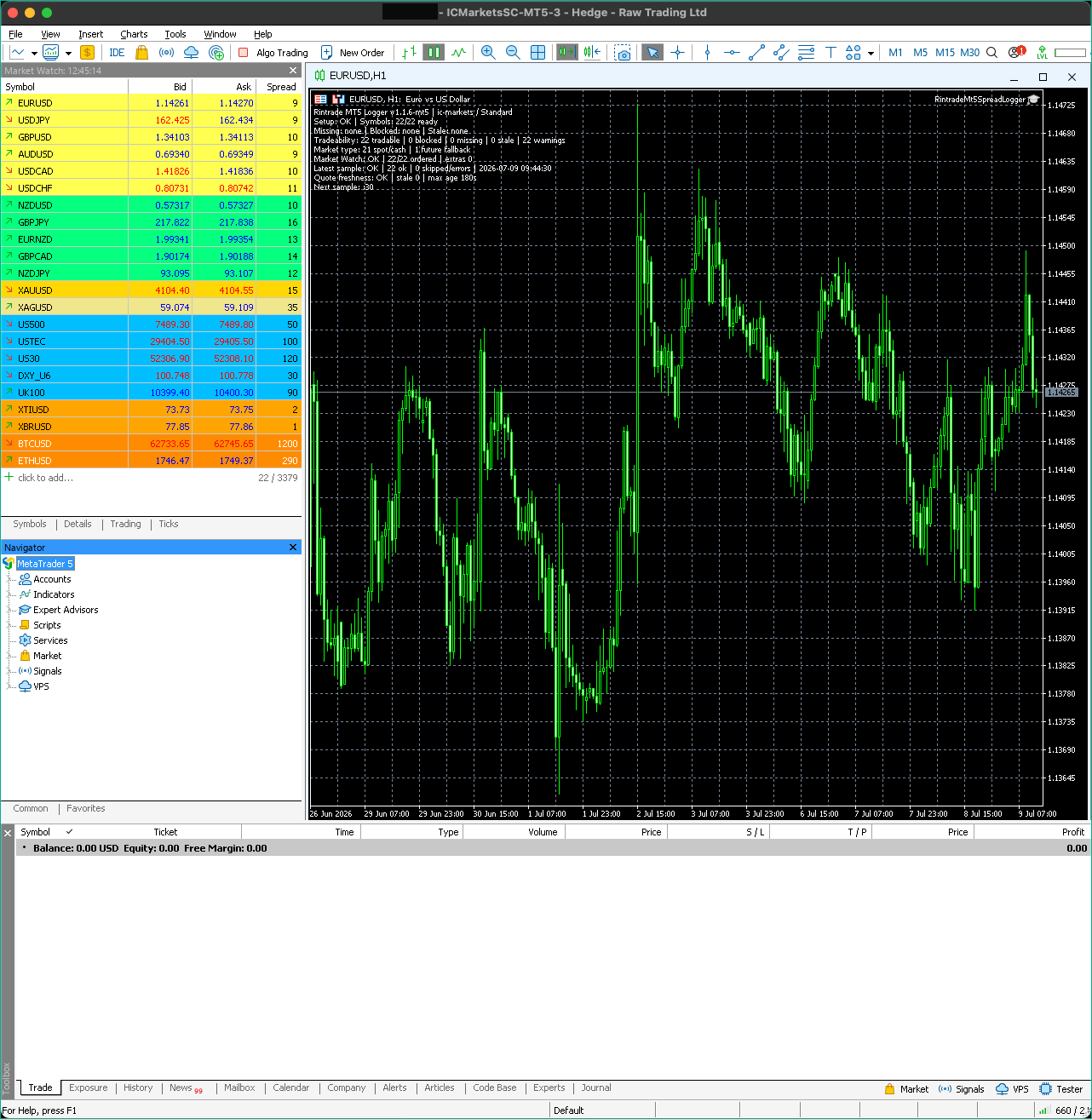
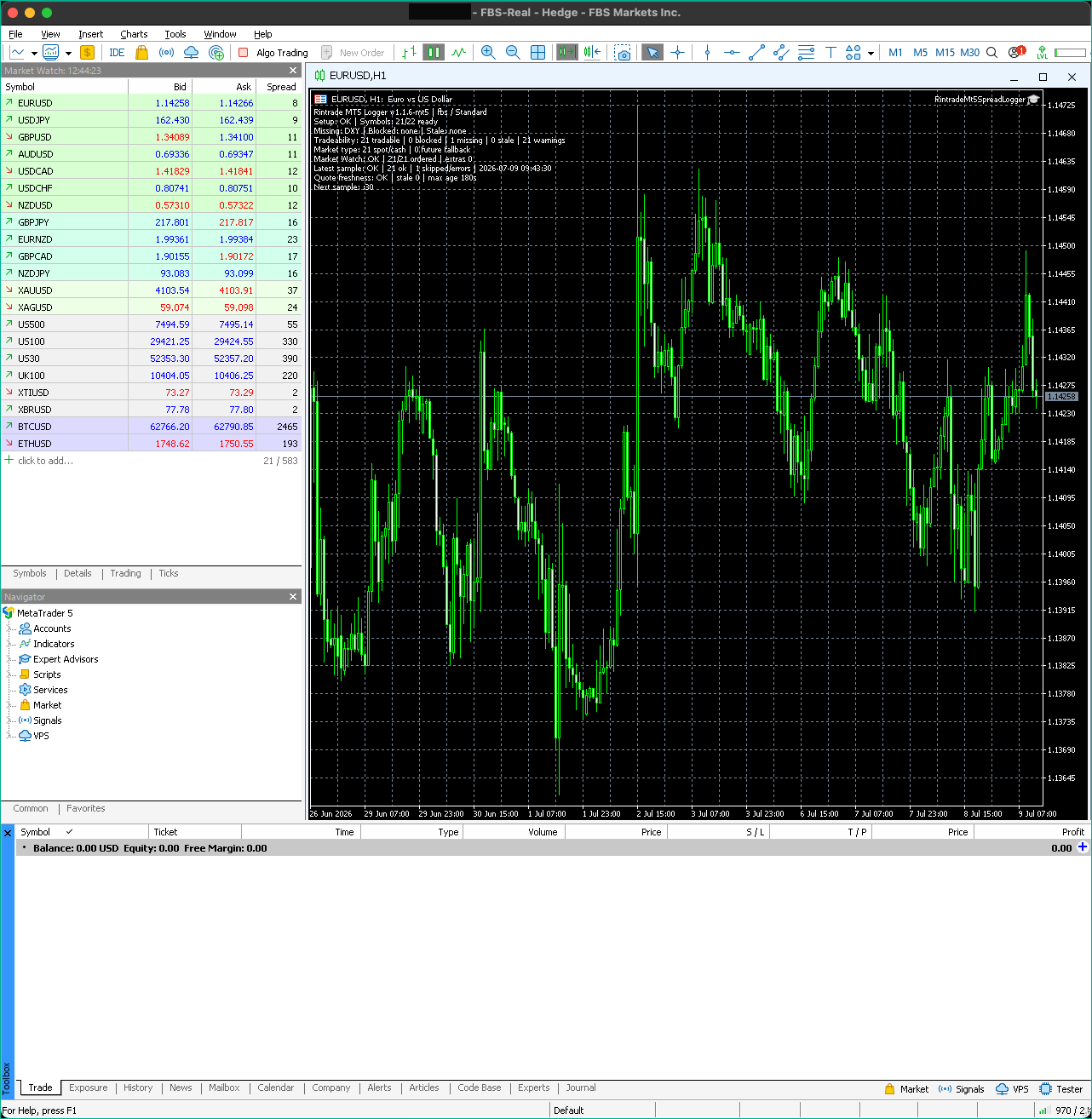
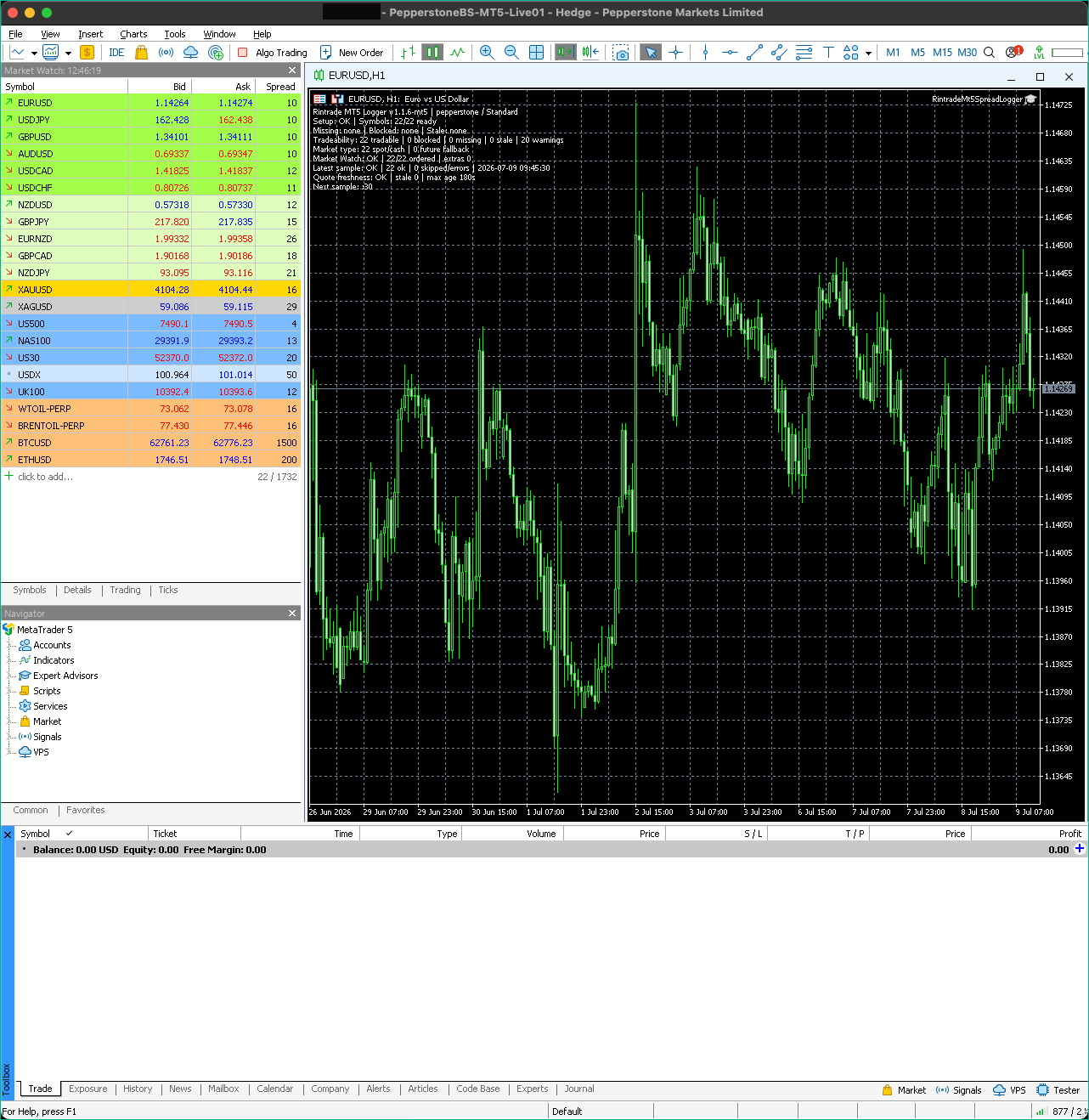
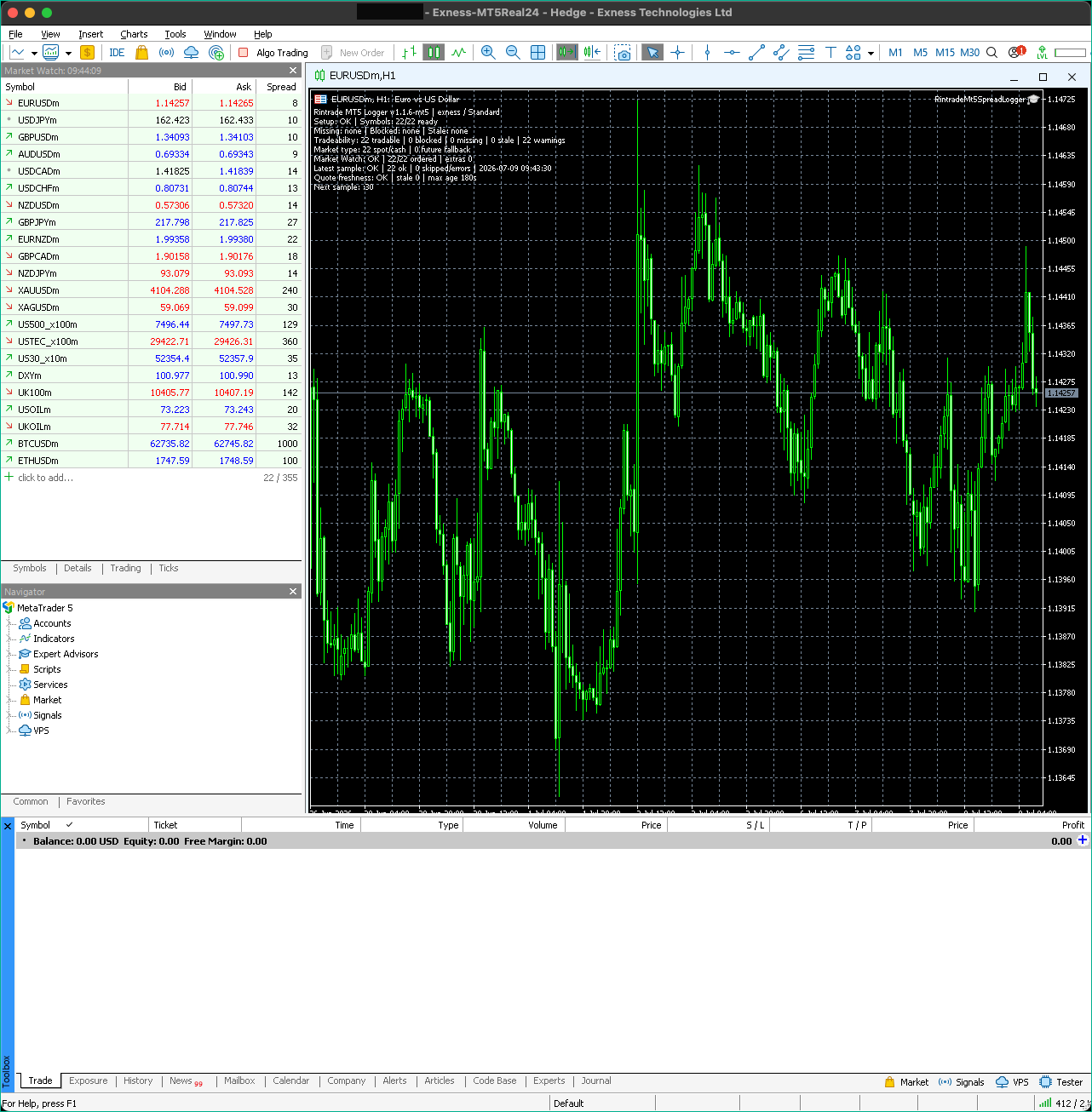
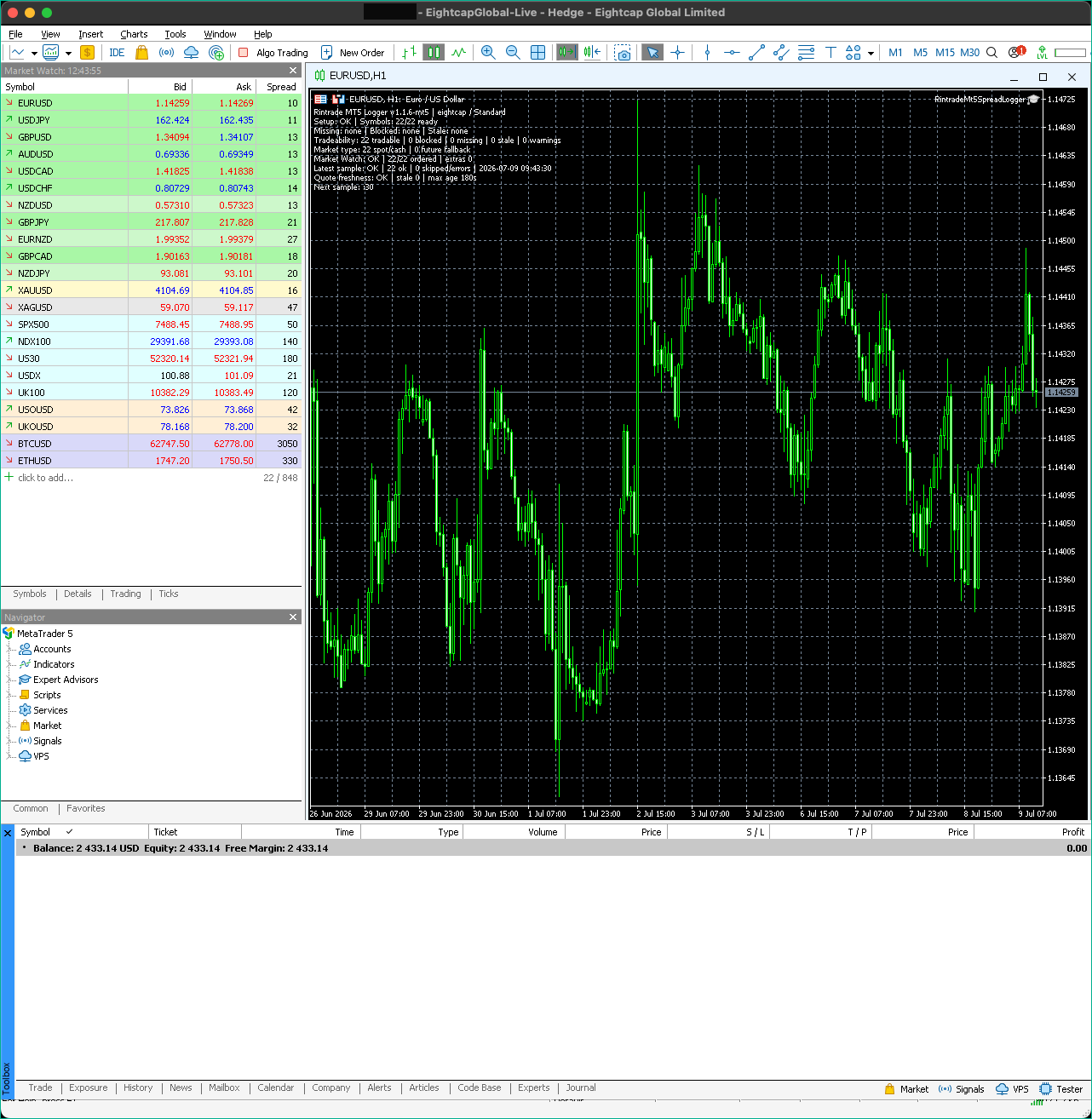
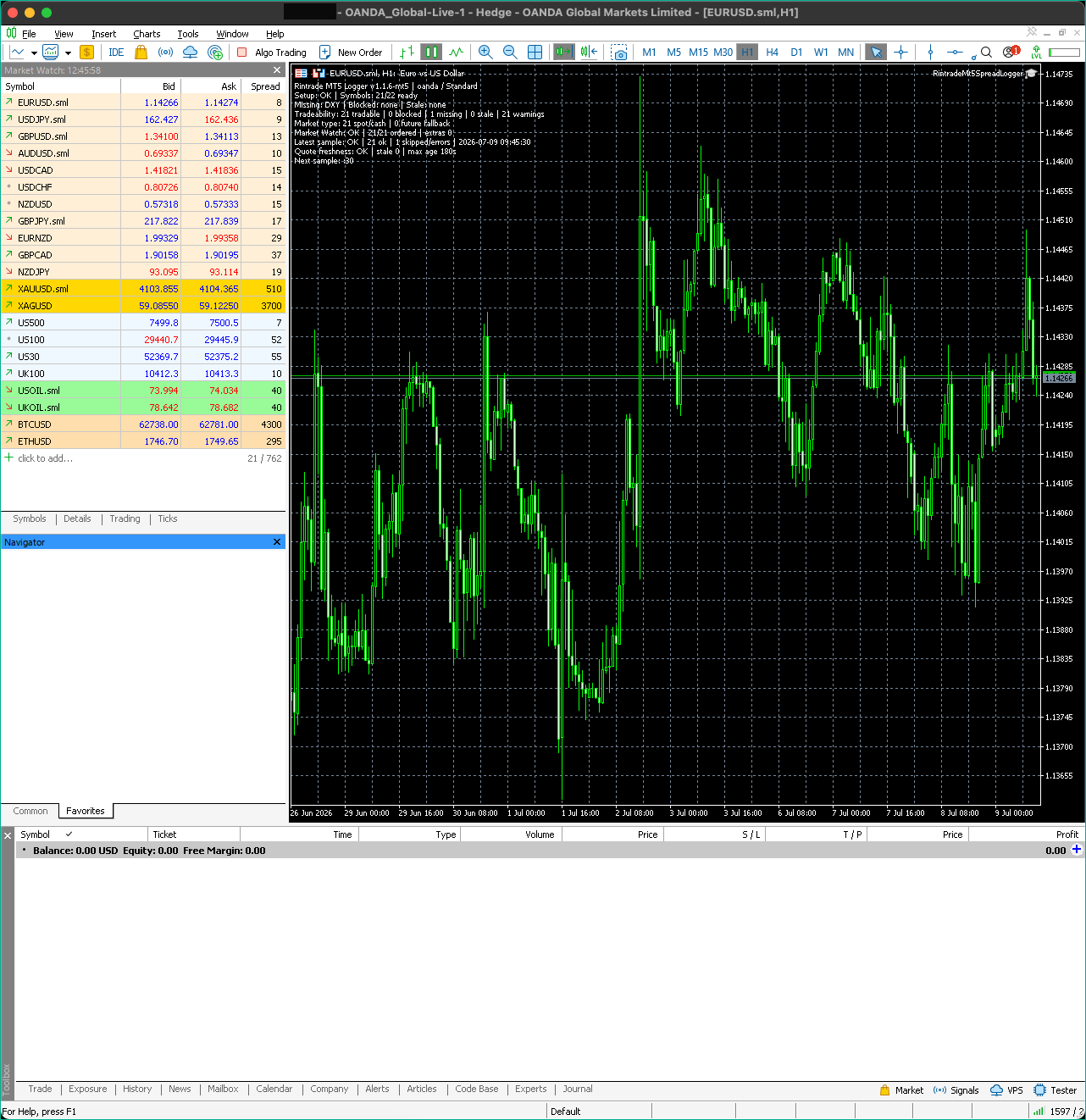
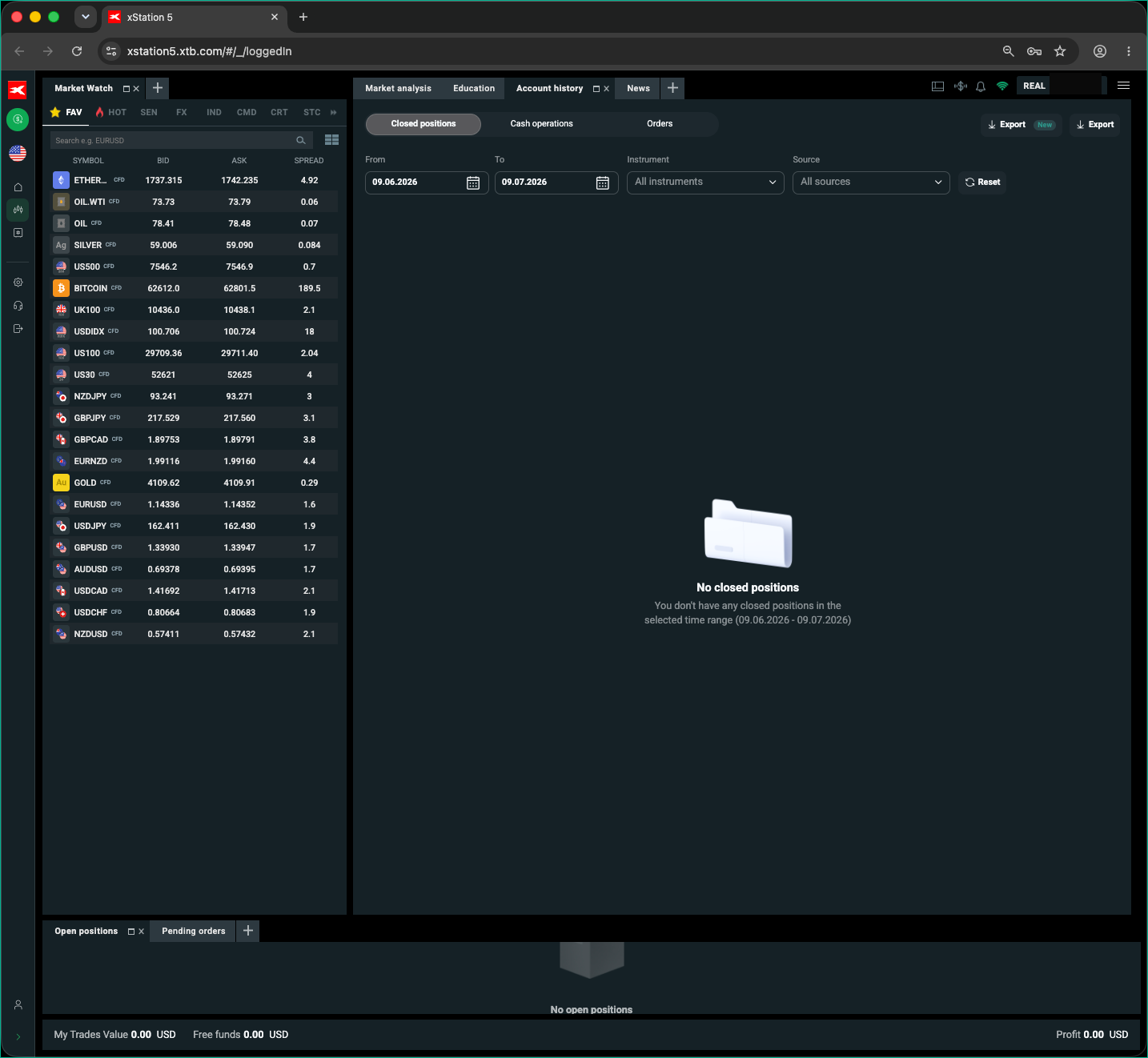
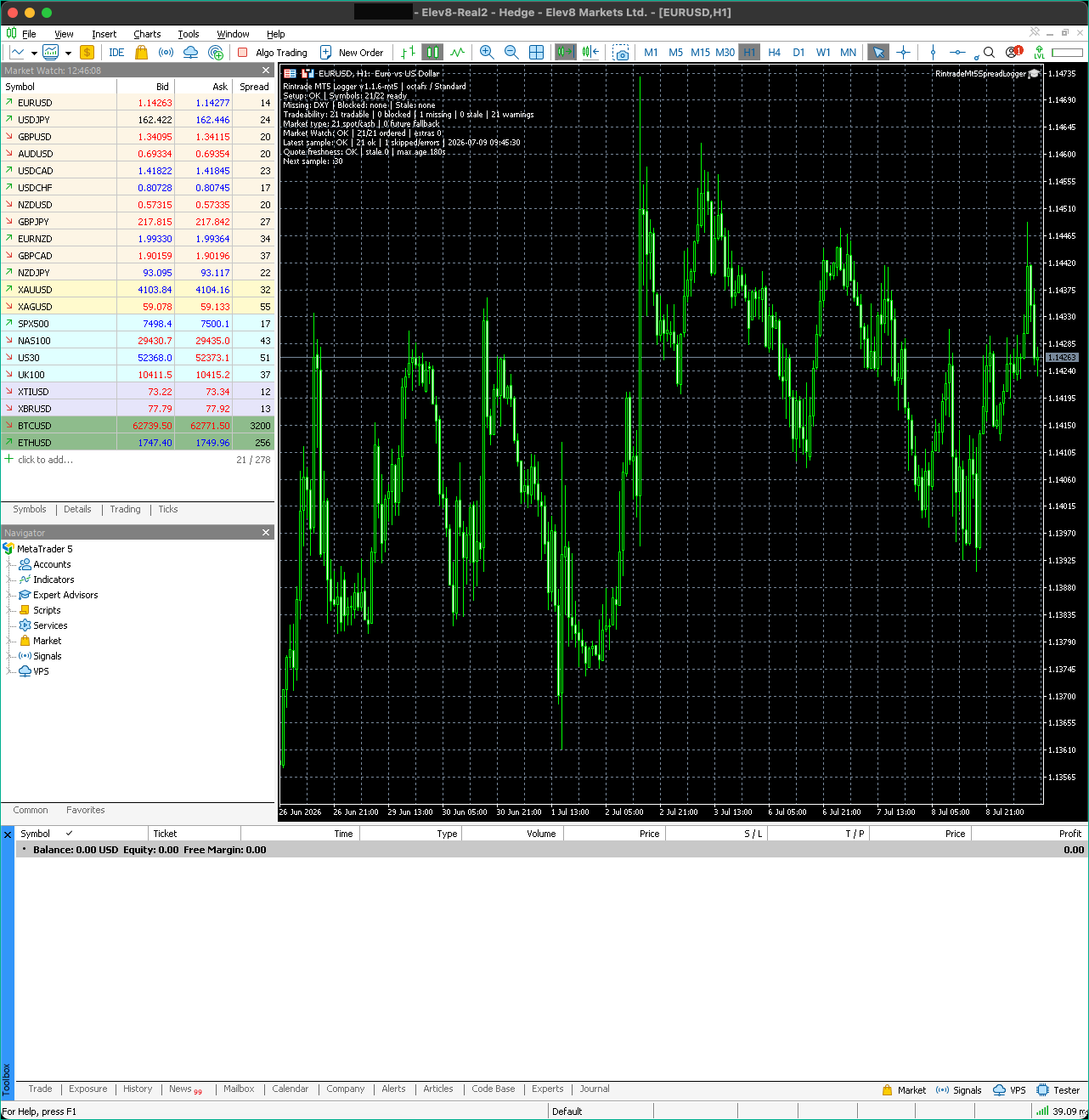
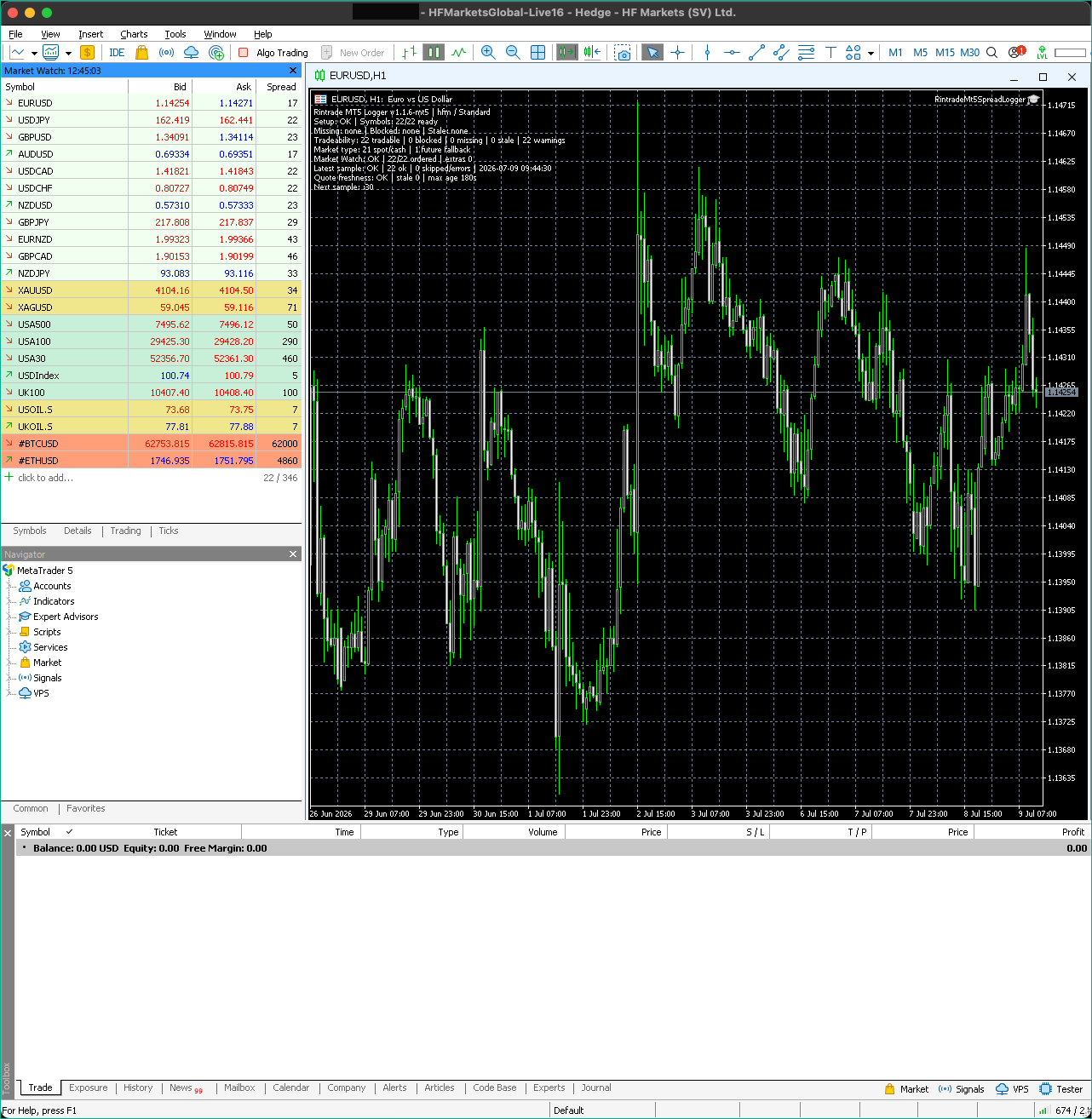
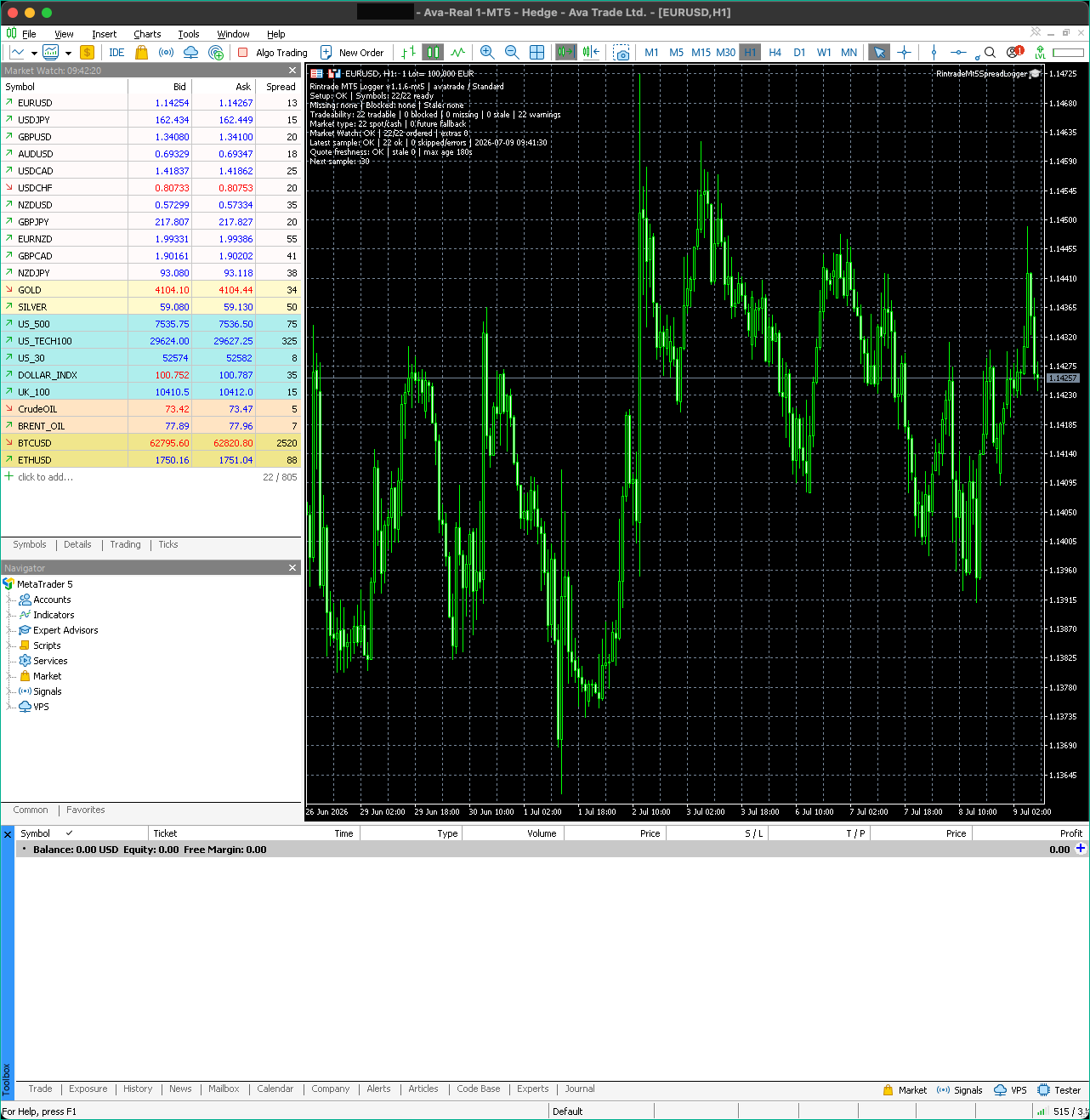
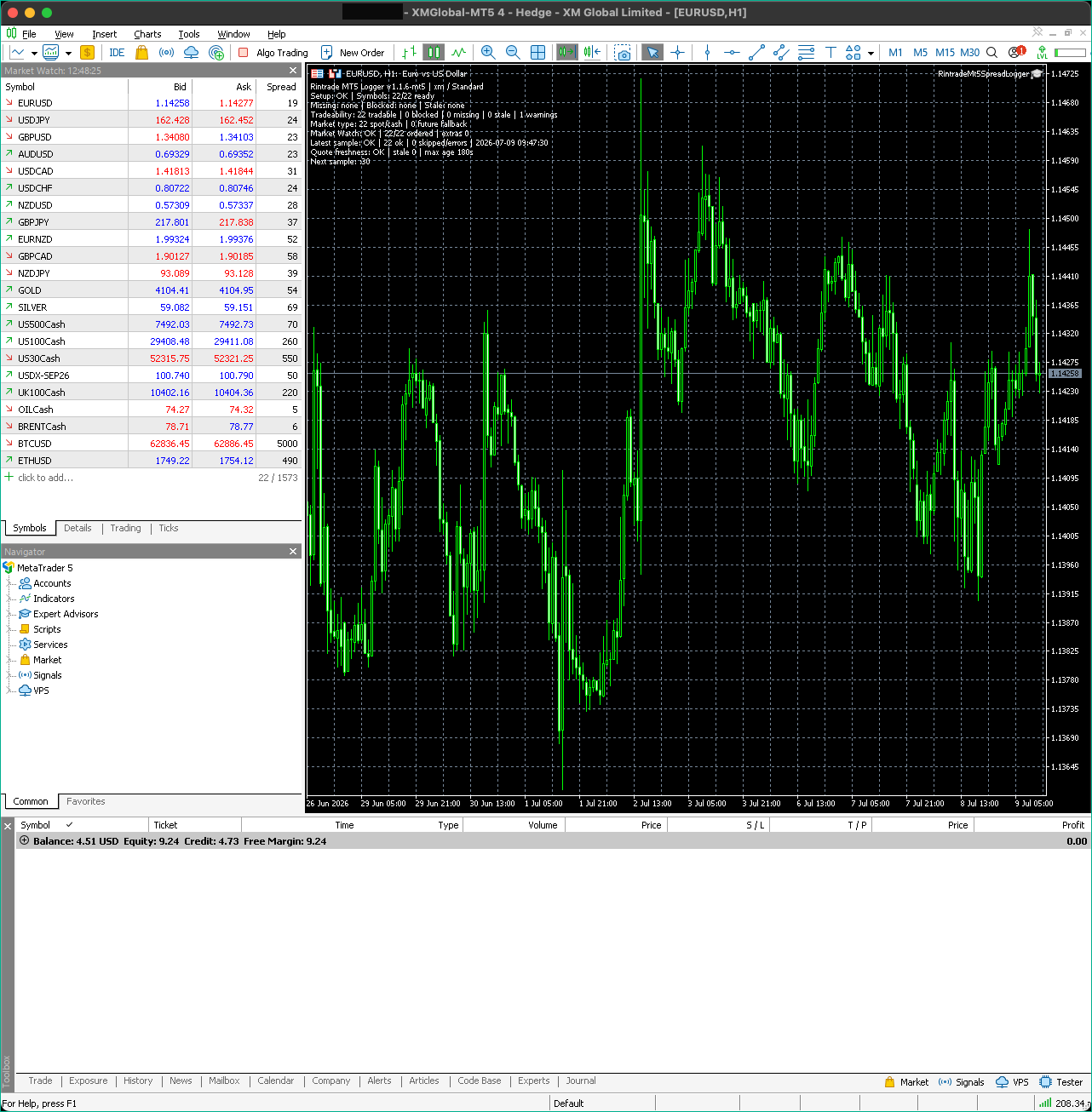
Each record below identifies the account type, platform, and server used for that broker. The screenshots document the tested setup; the spread statistics come from the synchronized CSV dataset, not from a single image.
IC Markets
- Account type
- Standard
- Platform
- MetaTrader 5
- Server
ICMarketsSC-MT5-3
FBS
- Account type
- Standard
- Platform
- MetaTrader 5
- Server
FBS-Real
Pepperstone
- Account type
- Standard
- Platform
- MetaTrader 5
- Server
PepperstoneBS-MT5-Live01
Exness
- Account type
- Standard
- Platform
- MetaTrader 5
- Server
Exness-MT5Real24
Eightcap
- Account type
- Standard
- Platform
- MetaTrader 5
- Server
EightcapGlobal-Live
OANDA
- Account type
- Standard
- Platform
- MetaTrader 5
- Server
OANDA_Global-Live-1
JustMarkets
- Account type
- Standard
- Platform
- MetaTrader 5
- Server
JustMarkets-Live2
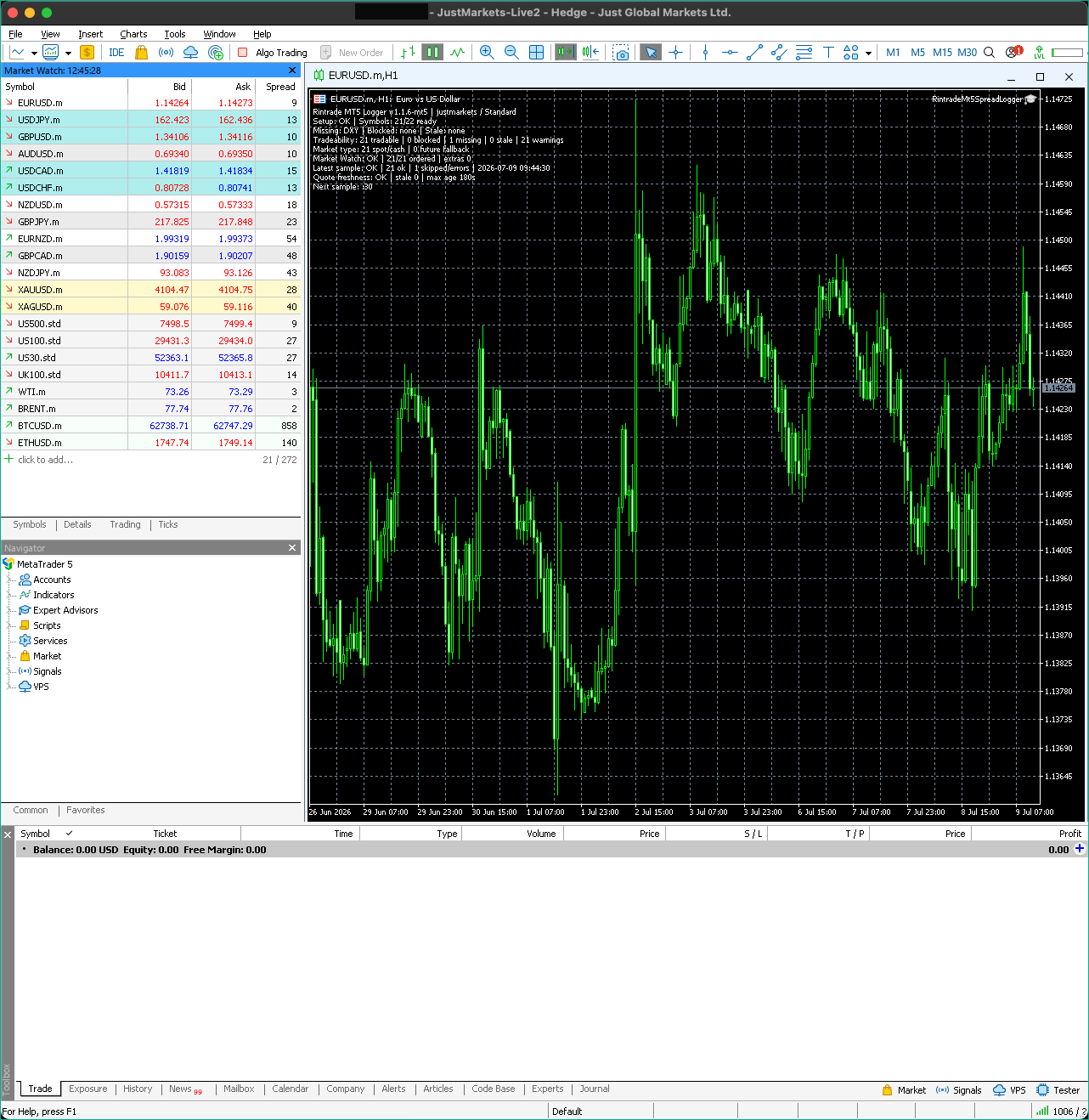
FP Markets
- Account type
- Standard
- Platform
- MetaTrader 5
- Server
FPMarketsSC-Live
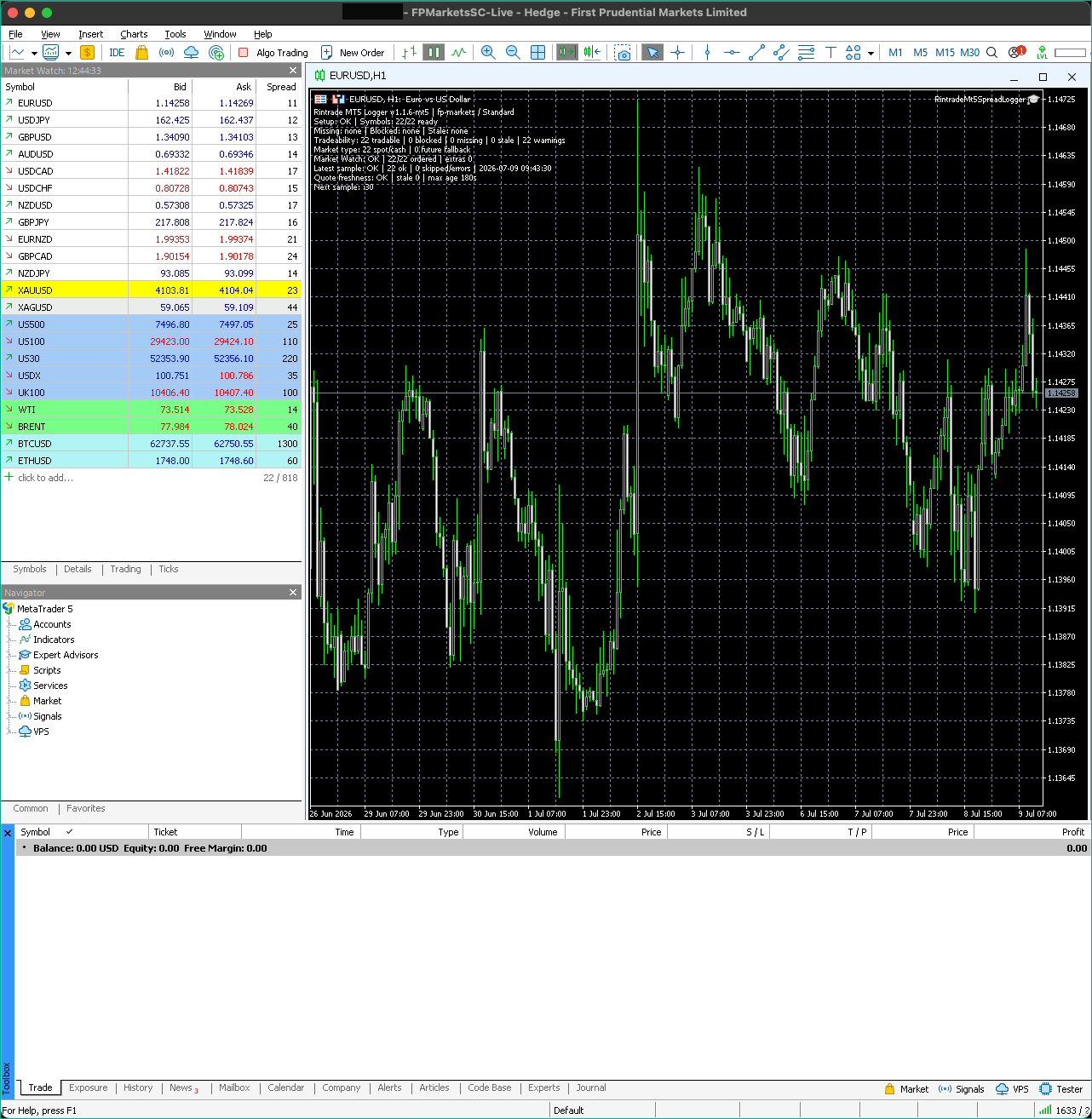
VT Markets
- Account type
- Standard STP (Standard-equivalent)
- Platform
- MetaTrader 5
- Server
VTMarkets-Live
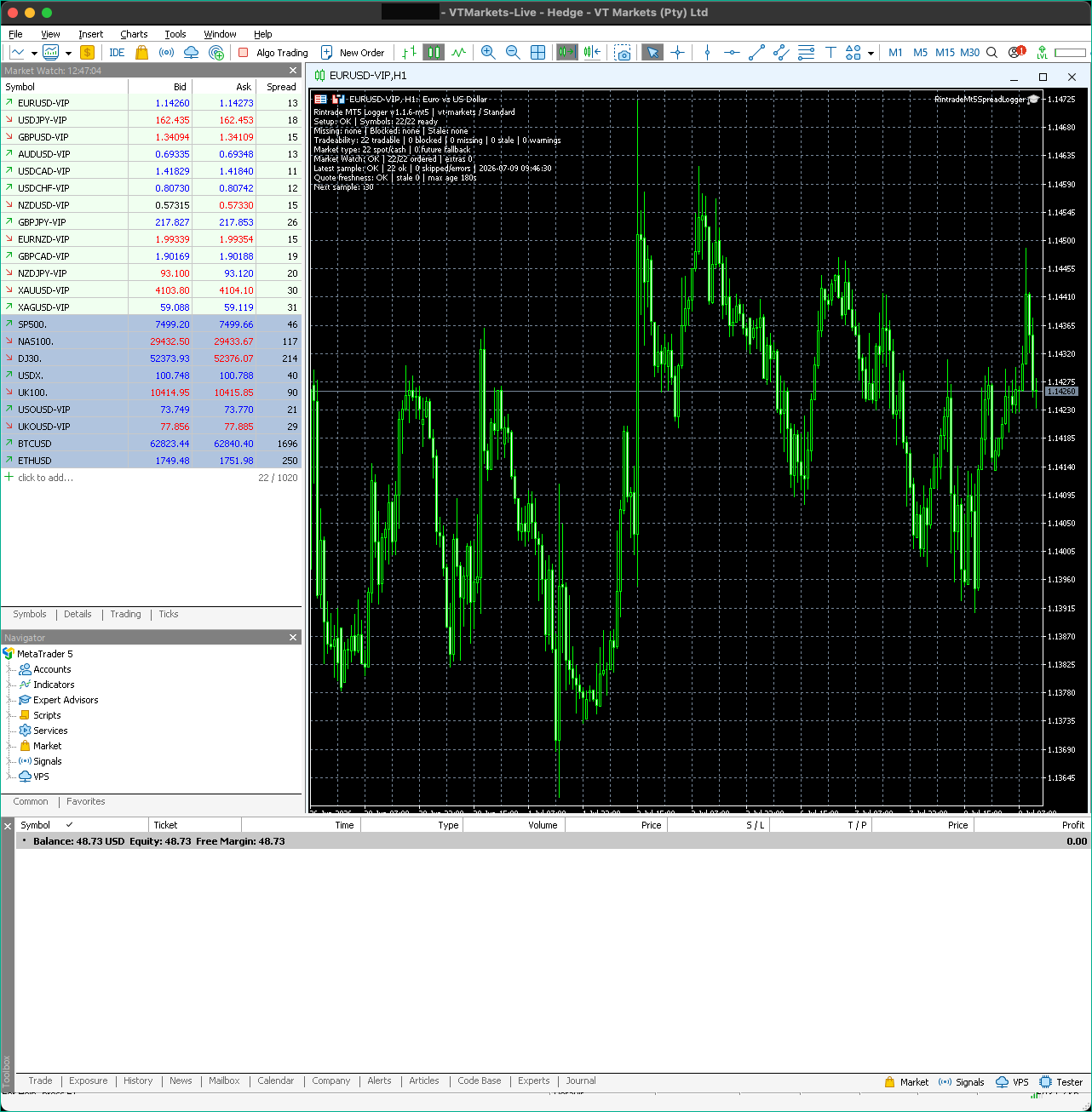
Vantage
- Account type
- Standard STP (Standard-equivalent)
- Platform
- MetaTrader 5
- Server
VantageMarkets-Live
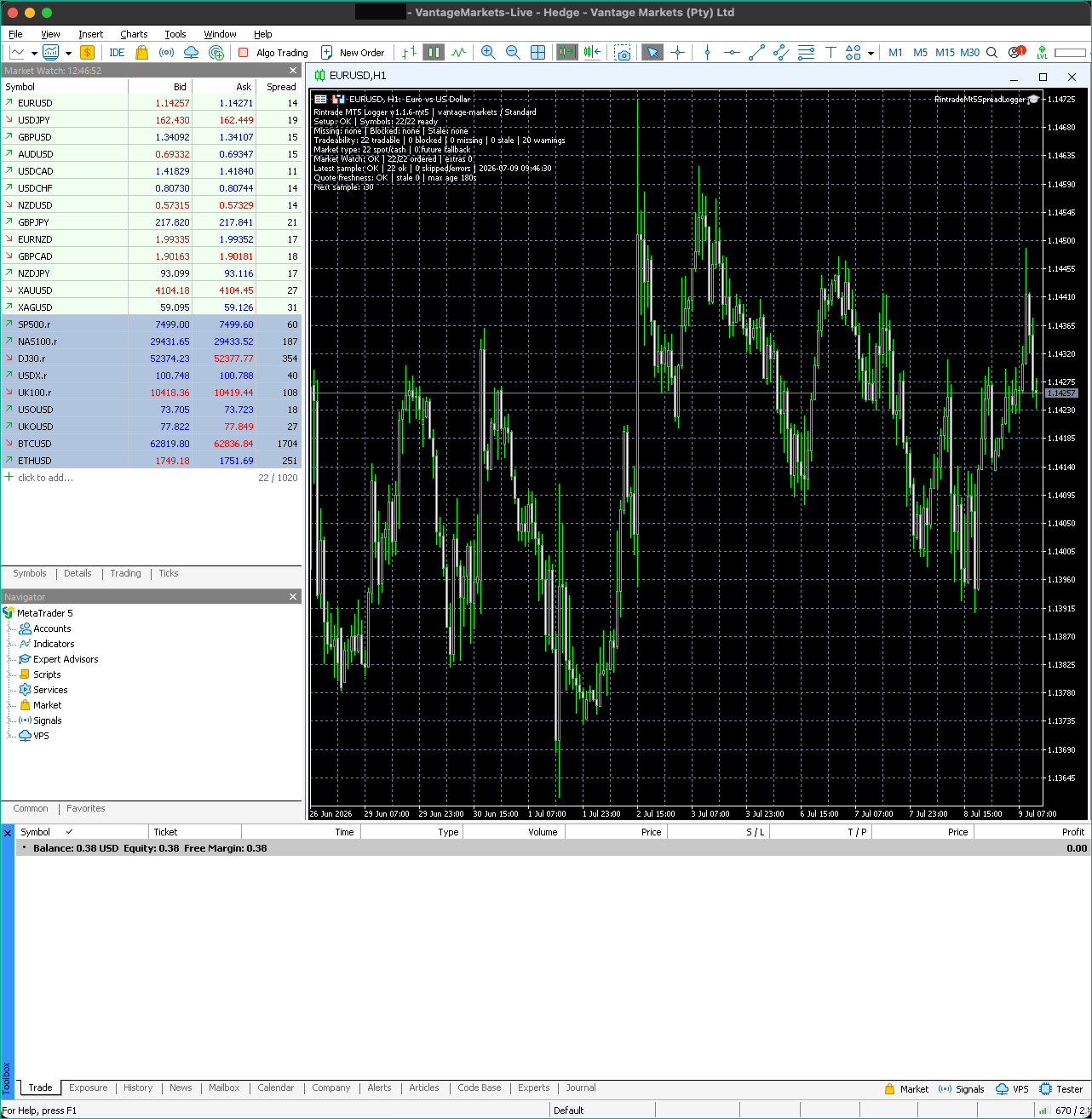
RoboForex
- Account type
- Pro (Standard-equivalent)
- Platform
- MetaTrader 5
- Server
RoboForex-Pro
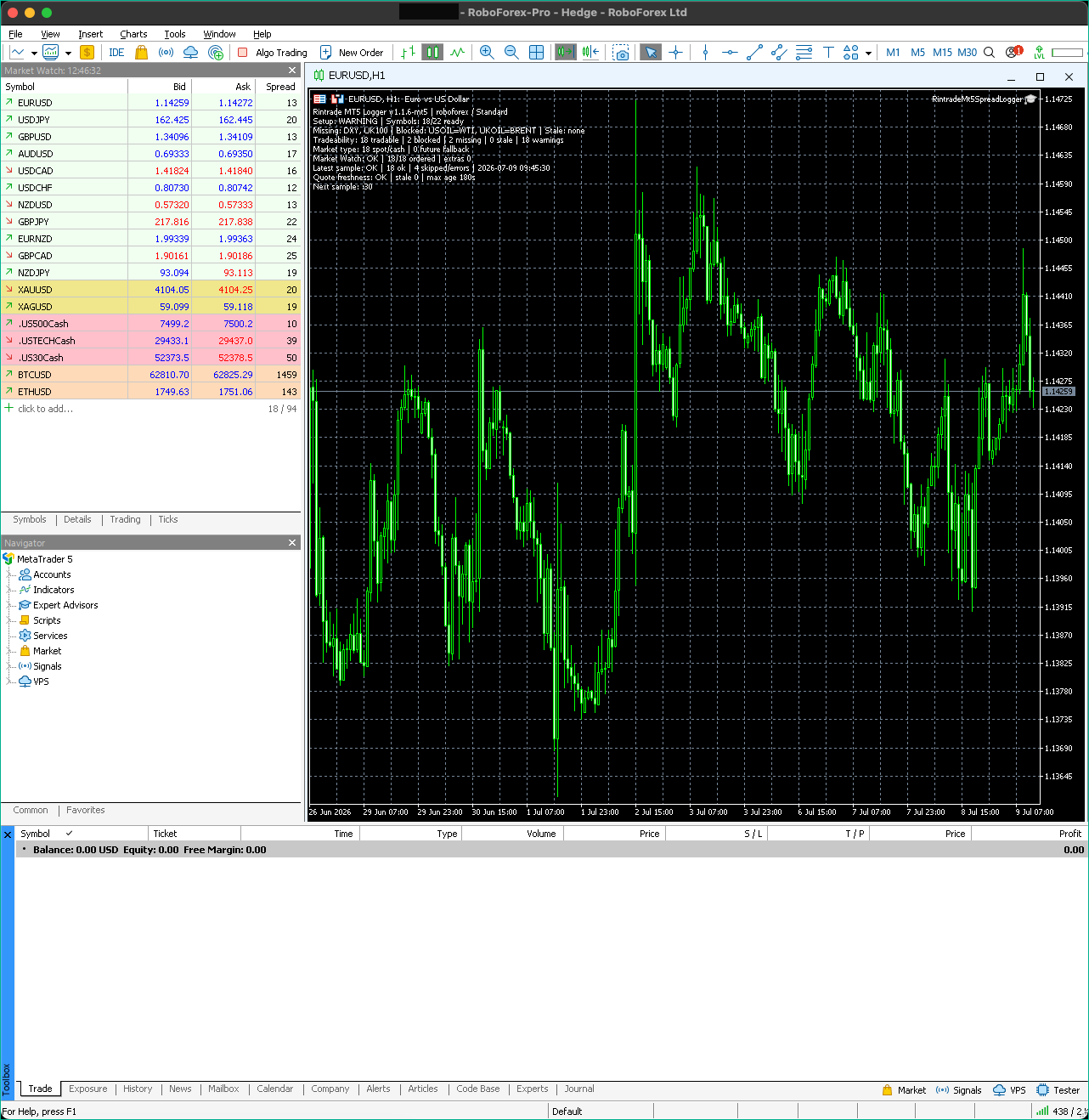
Tickmill
- Account type
- Classic (Standard-equivalent)
- Platform
- MetaTrader 5
- Server
Tickmill-Live
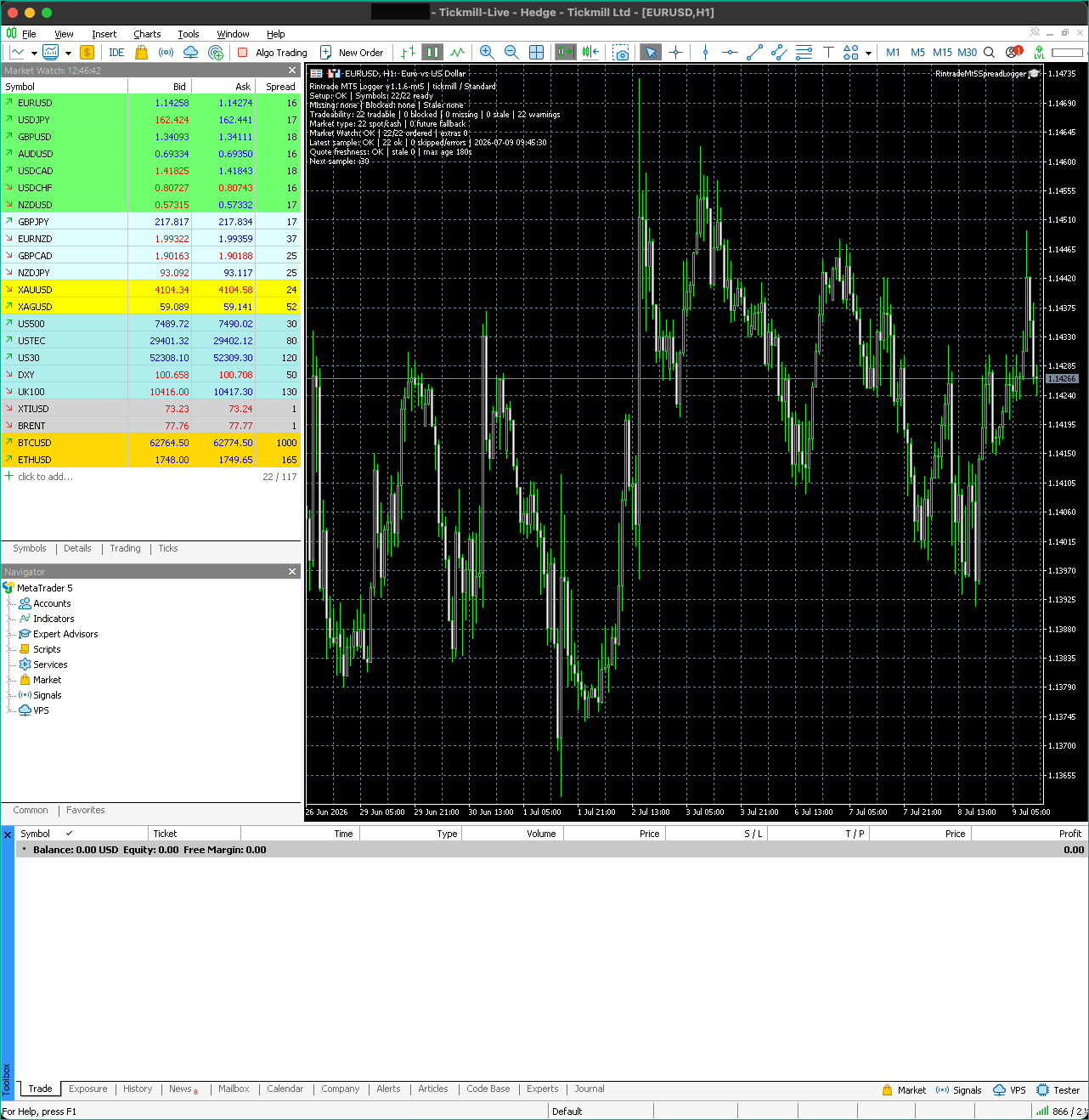
LiteFinance
- Account type
- Classic (Standard-equivalent)
- Platform
- MetaTrader 5
- Server
LiteFinance-MT5-Live
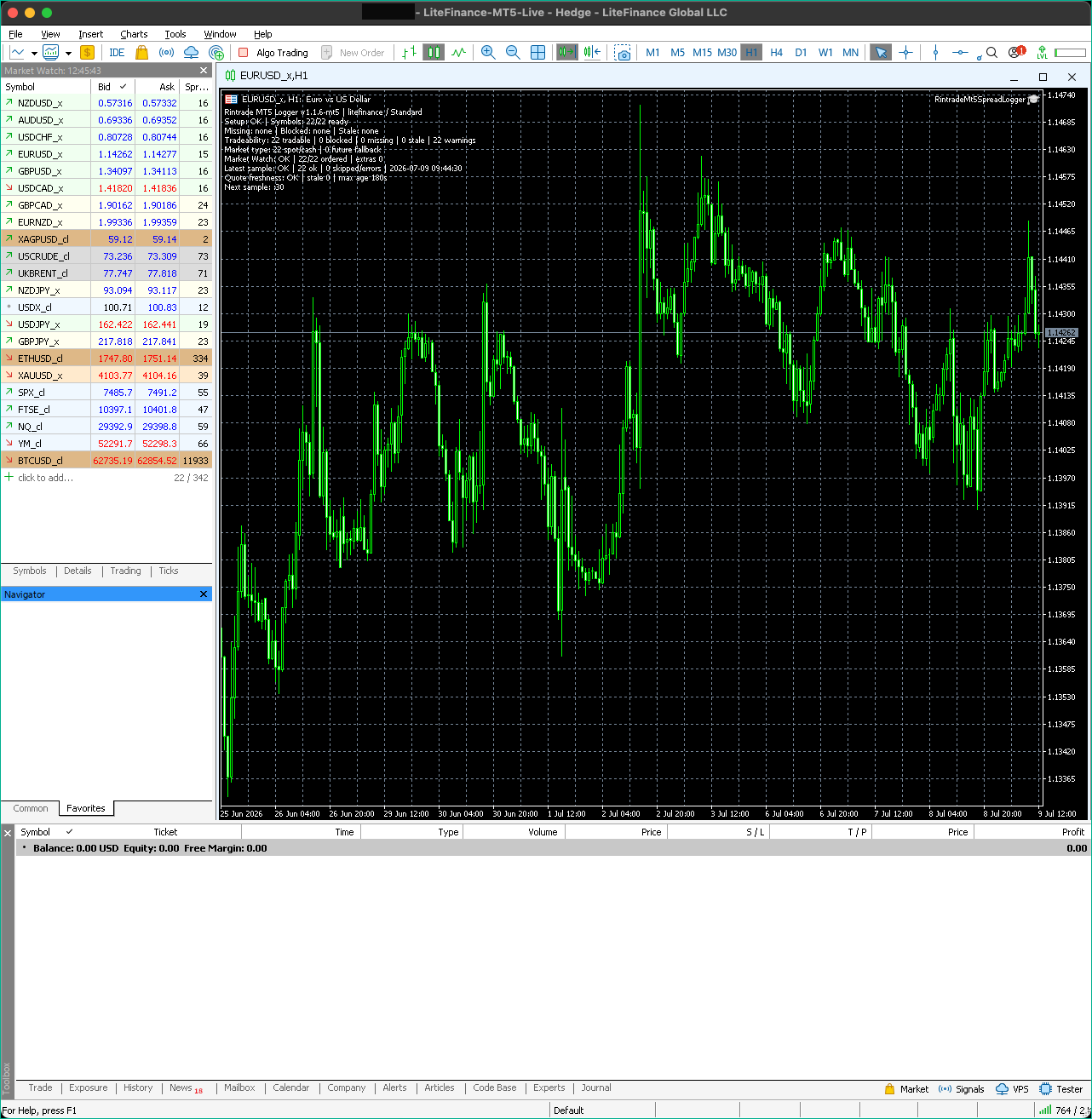
FxPro
- Account type
- MT5 Standard (Standard-equivalent)
- Platform
- MetaTrader 5
- Server
FxPro-MT5
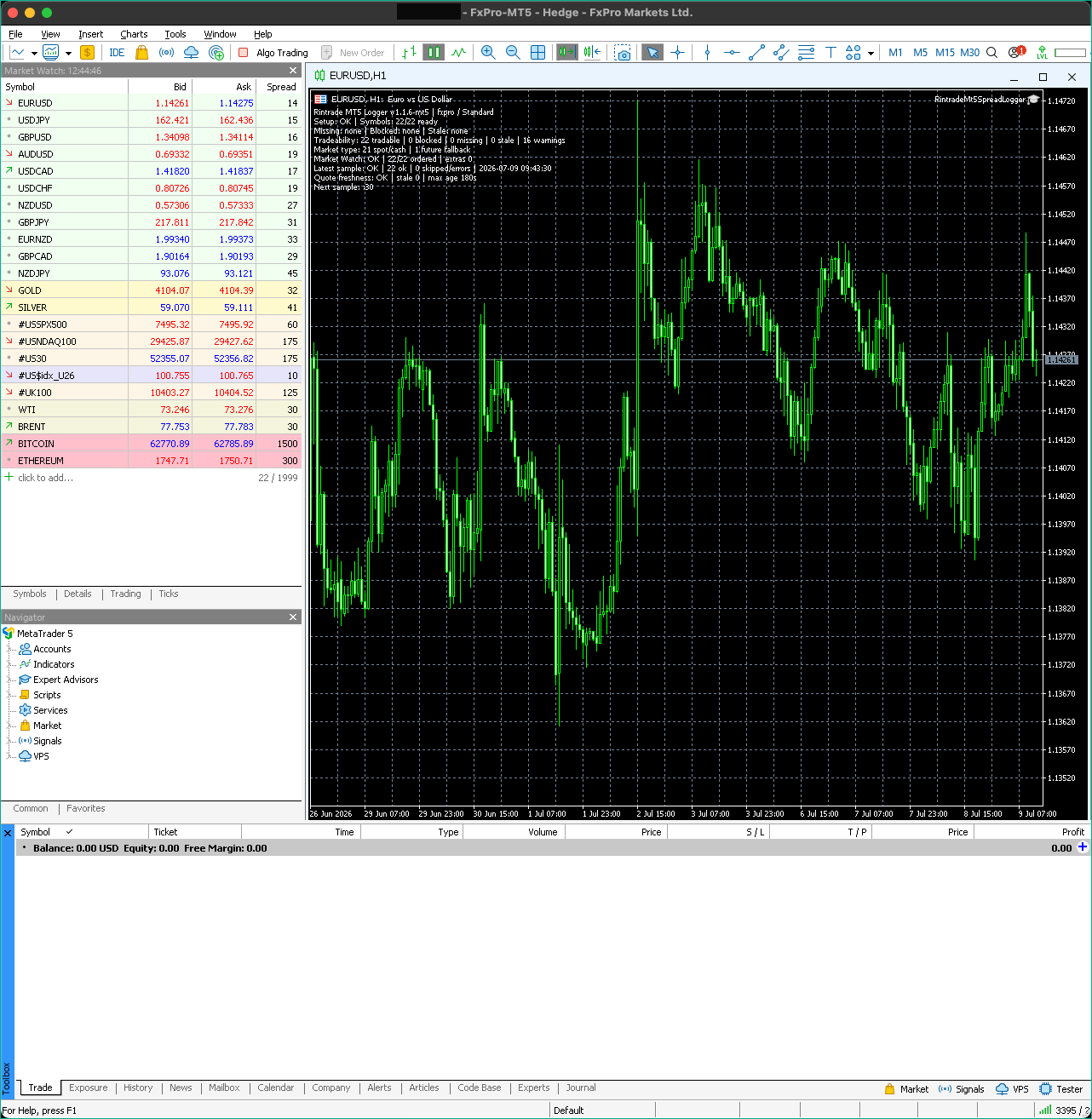
XTB
- Account type
- Standard
- Platform
- xStation 5 Web
- Server
xStation5-Web
OctaFX
- Account type
- MetaTrader 5 account (Standard-equivalent)
- Platform
- MetaTrader 5
- Server
Elev8-Real2
HFM
- Account type
- Premium (Standard-equivalent)
- Platform
- MetaTrader 5
- Server
HFMarketsGlobal-Live16
AvaTrade
- Account type
- Spread-based retail account (Standard-equivalent)
- Platform
- MetaTrader 5
- Server
Ava-Real 1-MT5
XM
- Account type
- Standard
- Platform
- MetaTrader 5
- Server
XMGlobal-MT5 4
How We Calculated the Rankings
The 7-pair avg. is the equal-weight mean of the seven pair-level average spreads for EUR/USD, USD/JPY, GBP/USD, AUD/USD, USD/CAD, USD/CHF, and NZD/USD. Each major pair contributes one seventh of the result, so a pair with more retained timestamps cannot receive extra weight. This is the only metric used to determine the ranking; Median, IQR, P95, Lowest, and Highest provide additional context.
Brokers are ordered from the lowest to the highest underlying 7-pair avg. Published spread values are shown to two decimal places, while rank distinctions use the study's three-decimal comparison and the data export keeps full precision. When two displayed 7-pair averages look equal but have different ranks, the rounding note shows both three-decimal values.
Limits of Our Lowest-Spread Forex Broker Test
The results are a detailed snapshot, not a permanent league table. Spreads respond to market liquidity and volatility, and a single July trading window cannot represent every session, rollover, news event, holiday, or stressed market. Repeating the measurement over more days and distinct sessions would improve temporal coverage and show whether rank differences persist.
Platform and entity context also matter. A broker can operate through multiple legal entities and offer different account names, symbols, markups, or product terms by jurisdiction. A quote seen on the tested setup should not be assumed to match every platform or country. Availability is not inferred from successful data collection; readers must verify their own eligibility and the entity that would hold their account.
We used live trading accounts for all 19 brokers, although the collection platforms differed. 18 accounts were observed in MetaTrader 5, while XTB was observed in xStation 5 Web. Synchronizing the schema and timestamps reduces one source of mismatch, but it cannot remove platform-specific quote-display or delivery differences.
We measured quoted bid/ask spread, not completed trades. The test does not measure fill price, rejected orders, requotes, latency, positive or negative slippage, execution speed, depth, or the difference between a displayed quote and an executable price at a chosen trade size. Those factors can change realized cost even when the quoted spread looks similar.
Nor is spread the same as total trading cost. Commission, swaps or overnight financing, currency conversion, inactivity charges, deposits and withdrawals, taxes, and instrument-specific fees are outside the dataset. We therefore do not describe any result as the cheapest broker overall. A trader who holds positions overnight or uses a commission-bearing account needs a different cost model from the spread-only comparison shown here.
Finally, small numeric differences should be interpreted with care. Measurement precision does not guarantee decision significance. A gap of a few hundredths of a pip in this window may reverse in another session. The 7-pair avg., Median, P95, IQR, pair-level results, and study limitations should be read together instead of treating rank alone as a prediction.
Download the 2026 Forex Broker Spread Dataset
Download all 67,659 synchronized observations used in this ranking, including timestamp, broker, currency pair, Bid, Ask, and spread in pips. The ZIP also contains one CSV per broker, aggregated results, methodology, a sanitized cleaning summary, and SHA-256 checksums.
Account numbers, account companies, servers, logins, local paths, and internal logger fields
are excluded. Study version: 2026-07-09-19-brokers-standard-accounts.
Lowest Spread Forex Brokers: FAQs
Are low-spread Forex brokers better for scalping?
Tight spreads matter more to scalpers because they open many short-duration trades and often target small price moves, so the Bid/Ask gap is paid repeatedly. But the lowest quoted spread does not make a broker the best choice for scalping on its own. Compare commission, execution quality, slippage, platform reliability, and the rules of the exact account you plan to use.
Should I compare minimum or average Forex spreads?
Start with the average. A minimum is the tightest spread a broker quotes, not the spread you should expect throughout the day. Compare averages for the same currency pair, account type, and trading period, then use P95 or the highest recorded spread to see how pricing behaved during less favorable minutes.
Are fixed or variable spreads better for active trading?
Neither is automatically better. Variable spreads can be tighter when liquidity is strong but may widen as market conditions change. If a broker offers fixed pricing, check when it applies, which exceptions the terms allow, and whether commission is charged. Compare the full cost during the hours you normally trade.
Can a wider spread trigger my stop-loss sooner?
It can. Depending on the broker and platform, stop-loss and take-profit orders can be triggered from Bid or Ask prices rather than the midpoint. A wider gap can therefore cause one side of the quote to reach an order level even when a single-price chart appears not to. Display both Bid and Ask where possible and check the platform's order policy.
Why do major currency pairs usually have lower spreads than exotic pairs?
Major pairs usually attract deeper liquidity and more trading activity, which tends to keep Bid and Ask prices closer together. Exotic pairs are generally less liquid and often quote wider spreads. This ranking covers seven major pairs only, so it should not be used to predict a broker's pricing on exotic pairs.